

Visit the National Palace of Pena in Sintra
The National Palace of Pena in Sintra is an ancient soul made of stone and lime, a witness to centuries of history, to the voices of queens and kings, to dreams lost over time. It is enclosed within the soul of Sintra, a pale gem that reflects the Portuguese sun. You immediately notice its two cone-shaped towers, which resemble chimneys or crowns rising above the palace. It has a Moorish soul and in its veins it still carries the Islamic heritage of its first cry, its first breath. The Arab people built it at the will of the emirs, but it later found its voice with the sovereigns of Portugal.
In its long life it has been a royal residence, a summer refuge, a treasure chest of secrets. A palace loved and restored by the many monarchs who have lived within its walls. Each of them has left an important mark on the building. A mosaic of styles, from Gothic to Moorish and Renaissance, like so many threads weaving an embroidery of the past. Visitors explore it for its azulejos, but also for its finely carved wooden ceilings that seem to tell legends suspended between sky and earth.
In the Sala dos Brasoes, the Hall of Coats of Arms, the ruling nobles still seem to watch over the palace as their emblems are displayed. A room filled with pride, but also with silence. A building that has seen alliances born, and has also seen them crumble beneath the shields of war. Its favourite room is the Sala das Pegas, where there are forty magpies painted on the ceiling. Essentially, each magpie represents a lady of the court who was involved in a kiss with the king. And so the sovereign, in order to quiet the gossip, had these magpies painted with the inscription “for the good”. A way to stop malicious tongues, but perhaps also to quiet his own conscience.
Then there are the courtyards surrounding the palace, full of light, cooled in summer and also full of whispers. The Central Patio reflects the brightness and footsteps, while the splashes of water echo Moorish melodies. Water is a vital element, jealously enclosed in every fountain. A kind of gift for the monarchs who reigned within its walls during the hottest summer days. Not to mention the royal kitchens and the famous tower-chimneys, perhaps the most photographed elements of all. And to the visitor, once inside, it will almost seem possible to smell the fragrances of the past, including spices, roasts and the almonds used to make sweets.
The palace is not just stone or merely a museum, but above all a vivid memory. The palace has witnessed the tears of defeated monarchs, the laughter of children, the sons of kings, the heartfelt sighs of lovers, and also the rustling of queens’ veils. A palace that was at once a refuge in times of plague and great wars, and also a place full of peace in moments of truce. From the palace terrace you can see all of Sintra, with its hills, its gardens and the sea in the distance.
The palace has seen the passing of the seasons, the colours changing. In the end it has managed to survive earthquakes, abandonment and renovations, always rising again stronger than before. If once its inhabitants were sovereigns or nobles, now they are curious visitors. Some stop to contemplate its wonders, others linger to take photos and capture precious moments of their visit. The National Palace of Sintra is not just a tourist stop, but a heart that beats within the stone. A piece of Portugal’s history that always has something to tell each person who crosses its threshold. What are you waiting for? Go and discover this Portuguese gem and you won’t regret it!
What to See at Pena Palace in Sintra
Sintra is a dream, a fairy-tale place where every small and large corner tells its own story. Every building has its own soul and every street is destined to lose itself in beauty. It lies less than an hour from Lisbon and is a blend of history, nature, mystery and art. What does it mean to visit Sintra? It means entering a world suspended between reality and fantasy.
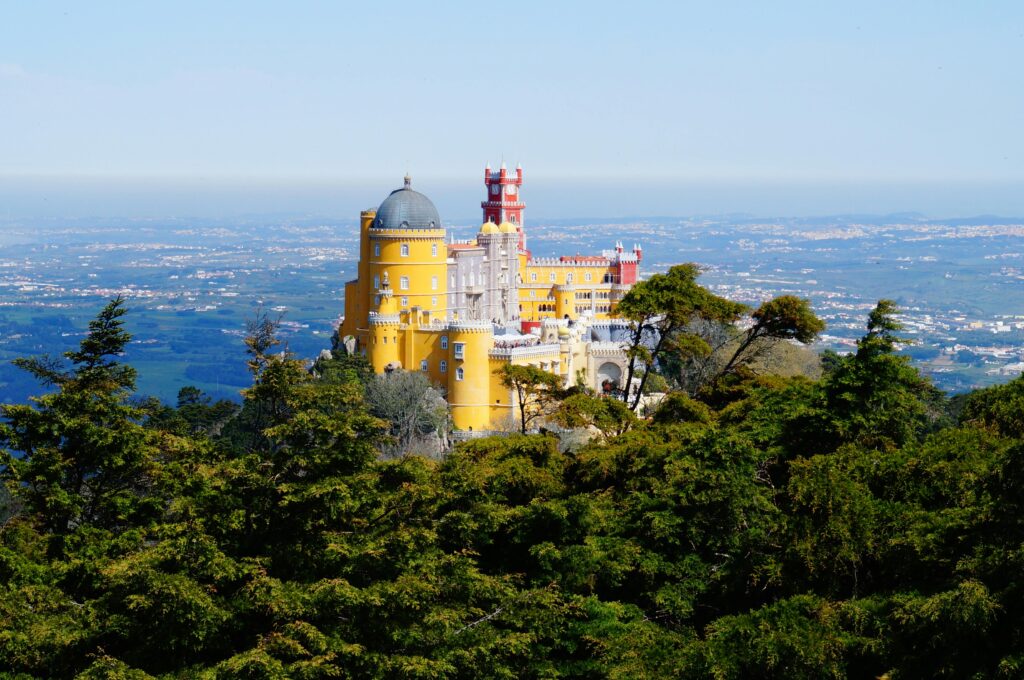
The symbol that represents Sintra is the Palacio Nacional da Pena (National Palace of Pena), which looms over the entire region from the heights of the Serra. The effect its view has is truly hard to put into words: yellow domes, scarlet walls, towers that rise up as if to touch the sky with a fingertip, while Moorish ornaments coexist in a synchrony of colours that trace the threads of a dream. Its construction dates back to the nineteenth century, on the ruins of an old monastery, and it is a true masterpiece of Portuguese Romanticism. It was commissioned by Ferdinand II as a summer residence for the royal family.
The palace contains a mix of different styles, both architectural and artistic. It starts from the Gothic and then moves through Manueline influences to the Renaissance and Moorish. Despite the many different stylistic nuances, everything comes together with remarkable harmony. The visitor who finds themselves walking through its halls will have the impression of leafing through the pages of an illustrated novel, with period furnishings, paintings, multicoloured glass and breathtaking panoramic views.
Unmissable is the Parque da Pena, a large romantic garden where winding little lanes, hidden lakes, giant ferns and centuries-old trees frame a setting that is almost fantasy-like. The Palacio da Pena is a fairy-tale castle, while Quinta da Regaleira is an adventure inside symbolism dense with esotericism. Its construction is owed to Monteiro between 1904 and 1910, in collaboration with the architect Manini. They brought to life an evocative villa with eclectic tones, which unfolds in a labyrinth of concepts related to the era of the Templars as well as to Freemasonry.
The protagonist of this location, however, is the garden, with caves, fountains, mysterious statues and the Initiatory Well. It is a spiral staircase that symbolises an “initiatory” path from death to rebirth. A place that certainly does not leave anyone indifferent.
Then there is the historic centre, animated by cobblestone streets and cafés filled with the scent of typical pastries called travesseiros. Here rises the Palacio Nacional de Sintra, recognisable for its two huge white conical towers. It is a royal palace that has been exceptionally well preserved and was once the favourite residence of various kings. Inside the palace you can find sumptuous rooms such as the Sala dos Brasoes, adorned with as many as 72 noble coats of arms, or the Sala dos Cisnes; they tell the story of the luxury of a bygone era. The architectural style is a melting pot of Gothic, Mudejar and Manueline influences.
Immersed in the misty vegetation of the Serra, a short distance from the palace, stand the remains of the Castelo dos Mouros, an ancient fortress built by the Moors in the ninth century. From here, Sintra can be contemplated in all its splendour on the clearest days. A location that conveys a sense of peace, offering a mystical silence. Ideal for those who love history, but also for those who prefer spectacular views.
A break in the historic centre of Sintra is a must, among pastel-coloured houses, artisan workshops and classic taverns. You absolutely must try the travesseiros, typical puff pastries filled with almond cream, as well as the queijadas, small cakes made with cinnamon and fresh cheese. Among the drinks, there is ginjinha, a delicious cherry liqueur often served in small chocolate cups.
Another attraction to visit is the Palacio de Monserrate, a triumph of romantic orientalism. The palace is surrounded by an exemplary botanical garden, perfect for anyone who wants to walk amidst an architectural style that recalls Indian, Gothic and Persian atmospheres. Time seems to stop and stretch here, because it is perhaps the quietest palace compared to the other, more crowded sites in Sintra. Its calm is pure magic. A dreamlike location that you do not simply visit, but where you breathe and live a second life.
Passes and Bundles
Useful info
Opening hours
The Park is usually open 09:00–19:00, and the Palace 09:30–18:30. Last admissions close earlier than the site—check your ticket for the exact cut-offs (they’re listed on the official page). Palace interior entry is by timed slot.
Location
Pena Palace crowns the Serra de Sintra above town. The Park has two public entrances—Main Entrance and Lakes Entrance—both signposted on the official “How to get there” page (with GPS coordinates if you’re mapping). Private cars aren’t allowed up to the monument.
How to get there
- Train from Lisbon → Sintra: CP Sintra Line from Rossio / Oriente / Entrecampos, then local transport up the hill.
- Bus 434 “Circuito da Pena”: one-way loop from Sintra train station → Moorish Castle → Pena → historic center → station. It’s the most convenient hop-on for the climb.
- On foot (scenic, steep): hike the Santa Maria / Seteais / Villa Sassetti trails through the forest if you fancy a workout.
- Driving: Park in Sintra and switch to bus/trail; vehicle access to the monument is not permitted.
Best time to visit
Go early (first slots) or late afternoon to dodge the big waves. Sintra’s micro-climate can be cool and breezy on the hilltop—bring a light layer.
Duration of the visit
Plan ~2–3 hours for the Palace + Park at a relaxed pace (more if you want to wander the lakes and viewpoints).
Accessibility
- Inside the Park: step-free paths exist; distances from gate to palace are ~600 m on the barrier-free route (steep). Manual wheelchairs by reservation; staff can assist to the shuttle pick-up.
- Shuttle: a paid transfer runs every ~15 minutes between the Main Entrance ↔ Palace (official supplement listed on the hours/prices page). Wheelchair boarding is supported.
- Palace interior: not fully accessible due to numerous stairs; café/restaurant/store areas are accessible with elevator and adapted restrooms.
Opening hours
The Park is usually open 09:00–19:00, and the Palace 09:30–18:30. Last admissions close earlier than the site—check your ticket for the exact cut-offs (they’re listed on the official page). Palace interior entry is by timed slot.
Location
Pena Palace crowns the Serra de Sintra above town. The Park has two public entrances—Main Entrance and Lakes Entrance—both signposted on the official “How to get there” page (with GPS coordinates if you’re mapping). Private cars aren’t allowed up to the monument.
How to get there
- Train from Lisbon → Sintra: CP Sintra Line from Rossio / Oriente / Entrecampos, then local transport up the hill.
- Bus 434 “Circuito da Pena”: one-way loop from Sintra train station → Moorish Castle → Pena → historic center → station. It’s the most convenient hop-on for the climb.
- On foot (scenic, steep): hike the Santa Maria / Seteais / Villa Sassetti trails through the forest if you fancy a workout.
- Driving: Park in Sintra and switch to bus/trail; vehicle access to the monument is not permitted.
Best time to visit
Go early (first slots) or late afternoon to dodge the big waves. Sintra’s micro-climate can be cool and breezy on the hilltop—bring a light layer.
Duration of the visit
Plan ~2–3 hours for the Palace + Park at a relaxed pace (more if you want to wander the lakes and viewpoints).
Accessibility
- Inside the Park: step-free paths exist; distances from gate to palace are ~600 m on the barrier-free route (steep). Manual wheelchairs by reservation; staff can assist to the shuttle pick-up.
- Shuttle: a paid transfer runs every ~15 minutes between the Main Entrance ↔ Palace (official supplement listed on the hours/prices page). Wheelchair boarding is supported.
- Palace interior: not fully accessible due to numerous stairs; café/restaurant/store areas are accessible with elevator and adapted restrooms.
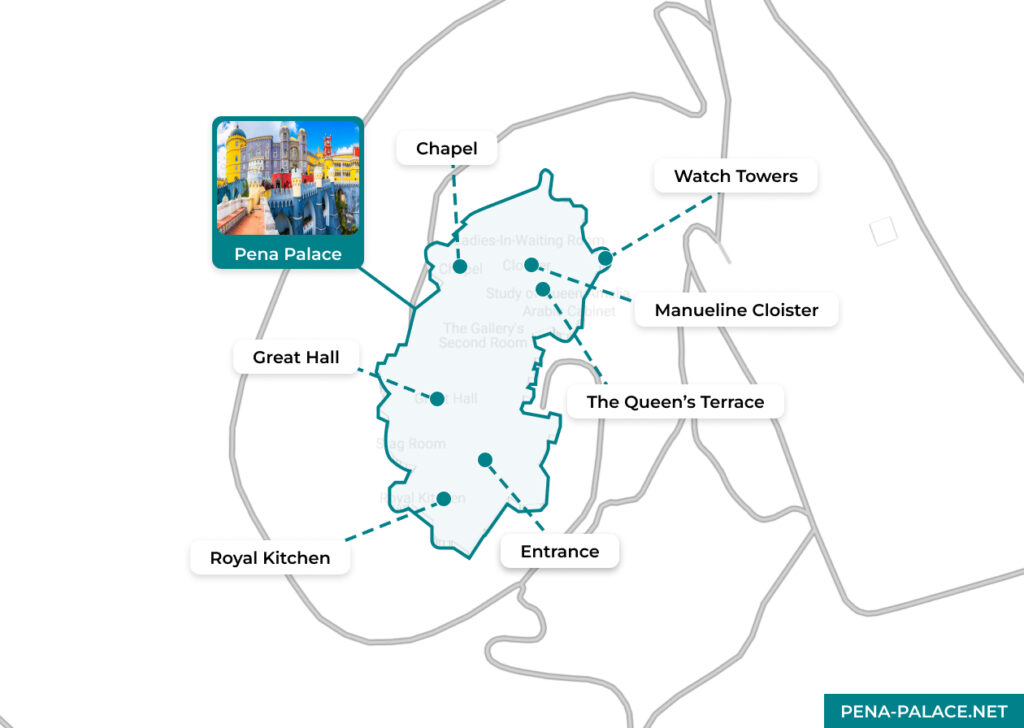
Map of Pena Palace